
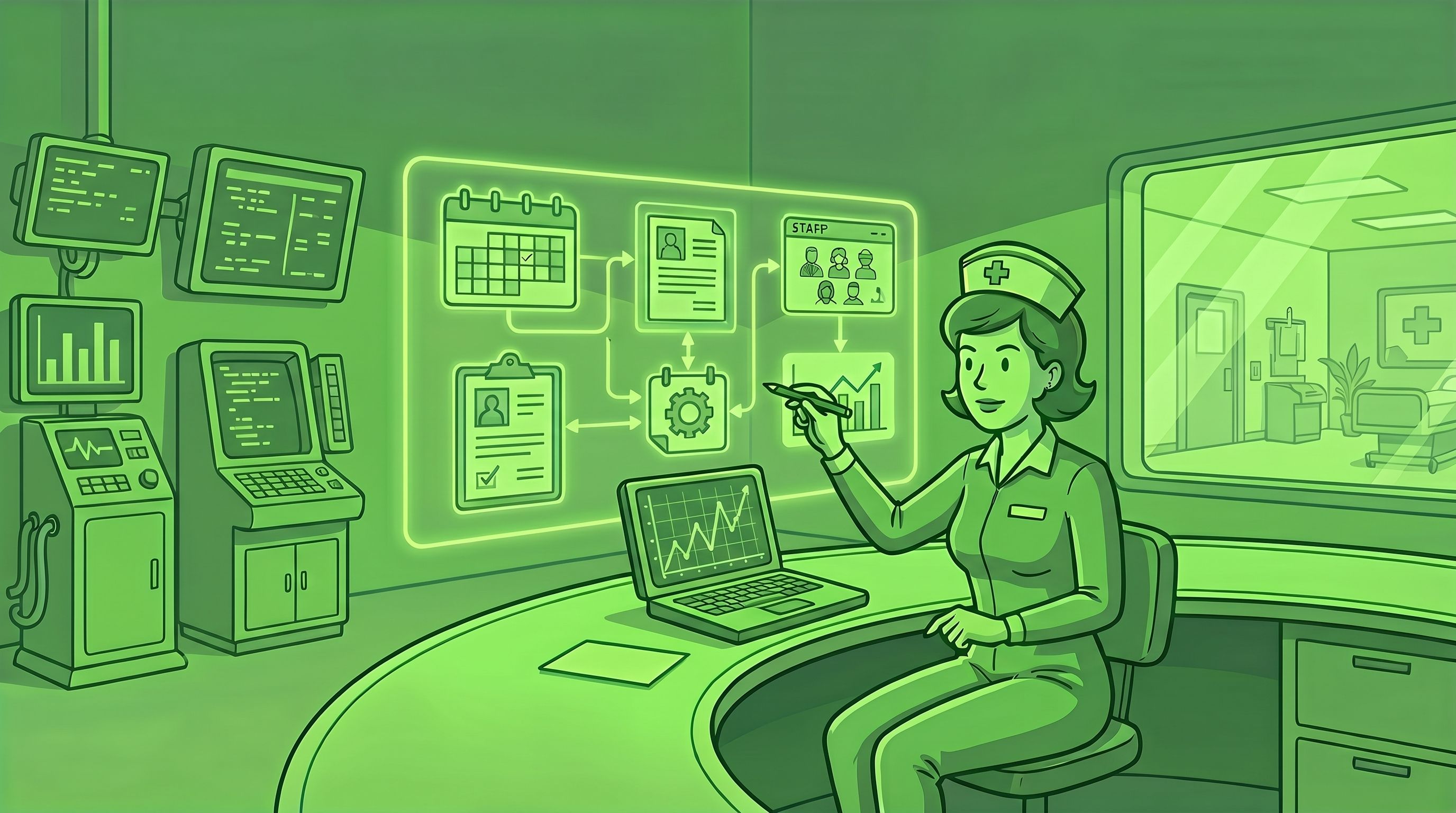
TL;DR. A 4-provider primary care practice cut weekly admin overhead by 40% — 12 hours to 7 — by connecting their EHR, scheduling, billing, and patient communication through a HIPAA-aware integration layer. Claim rejection: 14% → 6%. No-shows: 18% → 11%. Tooling: ~$1,450/month. The catch: HIPAA changes the integration playbook in three specific ways. Browse the patient and customer service tools we used.
Composite case study — the practice is real, the numbers are real, but identifying details have been changed and some specifics blended with patterns from two other healthcare practices in the same band. The math of the fix is accurate.
The practice. Four providers — three MDs, one PA. About 2,200 active patients across primary care and a small in-house behavioral health track. Roughly $2.4M in annual revenue. Twelve staff plus the providers. Single location. Independent — no health-system affiliation.
The problem. Patient intake, the EHR, billing, and follow-up communication ran on four platforms that didn't talk to each other. Every patient touched three of them. The practice manager estimated 12 hours of weekly admin overhead just moving information between systems — re-typing intake forms into the EHR, reconciling the schedule across the front desk and the providers, chasing missing data on rejected claims, batching follow-up reminders by hand every Friday afternoon. Claim rejection rate was 14%, well above the <5% benchmark high-performing practices target per Experian's State of Claims 2025. No-show rate was 18%, in the upper band of the 5–20% range Curogram's 2025 review cites for primary care.
The practice manager had been there nine years. She wasn't asking for AI. She was asking for the same patient's information to stop appearing in three different states across three different screens.
The starting state — where the friction lived
The friction concentrated in four places, each a manual handoff between systems that didn't share data.
Friction 1: Intake forms re-typed into the EHR. Paper packets at check-in, separate online history forms, all typed into the EHR by hand. ~3 hours/week.
Friction 2: Scheduling conflicts. The front desk used the EHR scheduler. Providers blocked time in personal Google calendars for charting, lunch, and admin. The two views drifted — patients booked into silently blocked time, schedule reshuffled the morning of. ~2 hours/week of rework, plus the patient experience cost.
Friction 3: Claims rejected for missing data. Wrong insurance ID, missing referral, ICD-10 mismatch — the biller emailed the MA, who dug through the EHR, fixed the source data, and re-submitted. ~3 hours/week. At a 14% initial denial rate on ~220 claims a month, the work was constant. Per Experian's 2025 report, industry-wide denial rates hit 11.8% in 2024 (up from 10.2%); high-functioning practices stay under 5%.
Friction 4: Patient follow-up batched manually every Friday. The practice manager pulled a follow-up list — annual physicals, lab redraws, behavioral health check-ins, post-procedure calls — and sent reminders one by one. ~4 hours/week. The list lived in a Google Sheet because the EHR's recall report was "useless after the first ten rows."
Total: 12 hours/week at $35–$45/hr loaded cost. ~$24K of labor on data movement alone — not counting revenue lost to no-shows or float cost of slow claim resubmission.
The connected stack — what got integrated
We didn't replace the EHR. We added a connected layer around it.
EHR: Athenahealth (existing). Already on athenaOne; we kept it. Replacing an EHR is a 12-month, six-figure project — the goal was to make the existing EHR the system of record and stop the leakage around it. Athenahealth exposes a FHIR R4 API, supports OAuth, and signs BAAs with certified marketplace partners.
Scheduling and patient engagement: NexHealth. NexHealth sits between the EHR and the patient: online self-scheduling, digital intake forms, two-way messaging, automated reminders, with real-time write-back to the EHR. Pricing from $299/month per practice; this practice landed near $450/month. NexHealth replaced the paper packet and the online intake form and owned the patient-facing reminder layer.
Billing: Athenahealth's native module. No new tool — just tighter data flow from intake (NexHealth) into the EHR's billing engine, so insurance, demographics, and referrals landed in the right fields before a claim was generated.
Patient communication: Klara. Klara is purpose-built for clinical messaging — HIPAA-compliant two-way text, structured triage routing, EHR-synced conversation history. Used for higher-touch clinical conversations: medication questions, behavioral health check-ins, post-procedure follow-up. NexHealth handled appointment automation; Klara handled clinical conversation. Practices this size typically land $300–$600/month.
Middleware: n8n, self-hosted. Here HIPAA matters. Zapier — the default SMB integration platform — explicitly does not sign BAAs and is not HIPAA-compliant for PHI workflows. The Zapier policy is unambiguous: Zapier can't be in your data flow if PHI is involved. We deployed n8n self-hosted on AWS in a HIPAA-eligible region with the cloud provider BAA executed, encrypted volumes, locked-down network access, audit logging, and MFA on every account — the controls that make a self-hosted n8n deployment HIPAA-defensible. For non-PHI workflows (vendor coordination, internal staff pings), a separate Zapier instance is fine.
Total monthly tooling for the new layer:
| Tool | Cost |
|---|---|
| NexHealth (scheduling + intake + reminders) | ~$450/mo |
| Klara (clinical messaging) | ~$450/mo |
| n8n self-hosted (AWS infra + BAA) | ~$120/mo |
| Athenahealth (existing — unchanged) | (unchanged) |
| Misc. monitoring + backups | ~$80/mo |
| Steady-state new layer | ~$1,100/mo |
Layered on the practice's existing tooling spend, total monthly stack landed around $1,450–$1,800 depending on patient volume and message throughput. Hold that number.
The HIPAA-aware integration approach
Healthcare integration is not SMB integration with extra paperwork. Three things had to be done differently.
1. BAAs first, integrations second. Every vendor touching PHI must sign a Business Associate Agreement before any data moves. We confirmed BAAs with Athenahealth, NexHealth, Klara, and AWS before the integration build started. Two vendors we initially considered got dropped at this step because they wouldn't sign — lost a week of evaluation, saved a six-figure breach risk.
2. No PHI in unmanaged middleware. The temptation in any integration project is to use the cheapest middleware available. For SMBs that's Zapier; for healthcare, that's a HIPAA violation waiting to surface. We ran two parallel automation paths: a HIPAA-defensible path (self-hosted n8n + BAA-covered vendors) for anything touching PHI, and a non-PHI path (Zapier) for back-office flows with no patient data. Drawing that line upfront is what prevents PHI from drifting into a non-compliant tool six months later.
3. Audit logging and access reviews are not optional. Every integration logs who accessed what, when. n8n audit logs ship to immutable storage. Vendor admin panels (Athena, NexHealth, Klara) get quarterly access reviews — old accounts get disabled when staff leave. The HHS HIPAA Security Rule requires this; the OCR breach portal fills up every year with practices that had no idea their integration logs had been silently failing for months.
These three rules add 15–20% to the implementation timeline versus a non-healthcare integration. They're not where you cut corners.
The 90-day rollout
Same three-phase shape as a non-healthcare integration project, with healthcare-specific gates inside each phase.
Days 0–30: BAAs + data audit. Execute BAAs with every PHI-touching vendor. Audit the patient database for duplicates, wrong demographics, stale insurance — clean inputs come before clean integrations. Map the existing data flow so the team can name what's about to change. Skipping this step means garbage flows between systems faster than clean data ever did — same lesson as the accounting firm case study, different vertical, identical failure mode.
Days 30–60: Integration build with phased PHI flow. Stand up n8n self-hosted in a HIPAA-eligible region with the BAA executed. Build the NexHealth ↔ Athenahealth intake + scheduling sync first (highest time savings). Layer Klara clinical messaging in next, scoped to behavioral health and post-procedure follow-up. Run every flow in parallel with the manual process for 14 days before cutover — same parallel-cutover pattern we recommend in the systems integration guide.
Days 60–90: Training + measurement. Train the front desk, MAs, biller, and providers. Retire the paper intake packet and the Friday Google Sheet. Stand up a dashboard tracking three metrics: weekly admin hours, claim rejection rate, no-show rate. By day 90 the practice had a stable system, documented procedures, and numbers. We transitioned out on a quarterly review cadence — important because integrations break in year two, not year one.
The before/after numbers
Measured at six months post-engagement.
| Metric | Before | After | Change |
|---|---|---|---|
| Weekly admin overhead | 12 hrs | 7 hrs | −42% |
| Claim rejection rate | 14% | 6% | −57% |
| Patient no-show rate | 18% | 11% | −39% |
| Friday follow-up batching | 4 hrs | 30 min | −87% |
| Annual admin hours recovered | — | ~260 hrs | — |
| Annual revenue recovered (no-show reduction at $180/visit avg)* | — | ~$28K | — |
| Annual labor recovered (at ~$40/hr blended) | — | ~$10K | — |
| Annual claim recovery (faster resubmits + fewer rejections)* | — | ~$15K | — |
| Net incremental tooling cost | — | ~$13K | — |
| Net annual gain | — | ~$40K | — |
*Estimates based on the practice's own volume and average visit revenue; rounded.
The 40% admin cut is the headline. The quieter wins — claim rejection 14% → 6%, no-shows 18% → 11% — are where the real money came from.
Per a JGIM study, two-way SMS reduces no-shows ~23% more than one-way messages. Per the MGMA Stat poll, August 2025, 87% of medical group leaders reported no-show rates flat or rising despite widespread reminder adoption. The difference between the practices that improved and those that didn't came down to whether the reminder system was integrated tightly enough with the EHR to know who to remind, when, and in what channel — exactly what this engagement fixed.
What didn't work, and what the practice doesn't recommend
Two failures are worth naming, because both are common.
They tried autonomous AI patient triage early. They turned it off after three weeks. Six weeks in, the practice piloted a third-party AI agent that promised to handle inbound patient messages autonomously — classify urgency, triage to a clinician only when needed, otherwise auto-respond. BAA on file, Klara integration. In production it false-escalated routine refill questions as "urgent," sent a tone-deaf auto-response to a patient with a recent loss, and twice misclassified clinical concerns as administrative.
The lesson wasn't that AI was wrong for triage — it was that AI on top of incomplete data was wrong for autonomous triage. The practice reverted to a human-in-the-loop pattern: a clinician reviewing every outbound message for 60 days, then case-by-case automation only on patterns that had been clean for 30+ days. Foundation first. AI second. Healthcare just makes the consequence of getting it wrong sharper.
They tried consolidating to a single all-in-one. They abandoned it. Before STOA engaged, they spent four months evaluating an all-in-one that pitched unified EHR + scheduling + patient comms + billing. Two months in they pulled the plug because every individual capability was weaker than the specialized tool it would replace — the scheduler had no provider-side calendar sync, the messaging tool didn't support structured triage, the billing module had narrower payer connectivity than Athena. The all-in-one math looked clean on a slide; in practice it would have downgraded three out of four core workflows to bring the fourth onto one login.
The lesson: in healthcare, specialized stack beats all-in-one because clinical, scheduling, billing, and communication workflows each have deep, specialty-specific requirements. Integration cost between best-of-breed tools is almost always lower than the cost of working in a weaker tool every day.
Four lessons for any 3–10 provider practice
The specifics — Athena, NexHealth, Klara, n8n, $1,450/month — are this practice's. The lessons are general.
1. The EHR is the system of record. Build around it, not over it. Friction usually lives in the layer around the EHR (intake, scheduling, communication, follow-up), not in the EHR itself. Replace EHRs only when the EHR is the actual constraint — rare in practices under 10 providers.
2. HIPAA is a sequencing rule, not a blocker. BAAs first, integrations second. PHI flows only through BAA-covered tools. Audit logging is mandatory. Get those right and most consumer-grade integration patterns translate cleanly.
3. Specialized stack beats all-in-one under 20 providers. Integration cost between best-of-breed tools is real but containable; the cost of working in a weaker tool every day, for years, isn't.
4. Layer AI on integration, never under it. Autonomous AI on disconnected data produces the worst outcomes — confidently wrong, at speed, with patients on the receiving end. Foundation first.
Where to take this from here
- Run the audit. Use the box-and-arrows exercise from the systems integration guide, with one healthcare addition: tag every box and arrow that touches PHI. That's your scope for HIPAA-defensible workflow design.
- Browse the tools. The patient and customer service tools, integration platforms, and automations directory cover the layers we used. Filter for HIPAA-eligible vendors first.
- Get a Stack Audit. Free 30-minute session for healthcare practices in the 3–10 provider band — not a sales call. We look at your stack and tell you what we'd fix first, with HIPAA constraints called out explicitly. Get in touch.
The structure of the fix — clean the data, BAA the vendors, integrate around the EHR, automate the highest-friction layer first — is reusable across primary care, specialty, dental, and behavioral health practices in this size band.
Frequently asked questions
How do healthcare practices integrate EHR with scheduling without breaking HIPAA?
Through BAA-covered, FHIR-aware middleware — not generic consumer integration tools. The pattern: the scheduling vendor signs a BAA, the EHR exposes a FHIR API (or a marketplace integration), and either the vendor handles the sync directly or a self-hosted, HIPAA-defensible middleware (n8n on a HIPAA-eligible cloud, with BAAs in place) brokers the data. Generic Zapier accounts cannot sit in this flow because Zapier does not sign BAAs.
Is Zapier HIPAA-compliant?
No. Per Zapier's data privacy documentation, Zapier does not sign Business Associate Agreements and is not HIPAA-compliant for workflows touching Protected Health Information. Zapier can still be used for back-office workflows with no patient data — vendor coordination, internal staff notifications — but anything touching PHI must move through a BAA-covered alternative. Self-hosted n8n on a HIPAA-eligible cloud (with the cloud provider BAA executed) is the most common SMB-friendly substitute.
What's the realistic ROI of integrating a healthcare practice's tools?
For most 3–10 provider practices: 200–400 admin hours recovered per year, a 30–50% reduction in claim rejection rate, and a 5–10 percentage point drop in no-show rate against $1,200–$2,000 in net incremental monthly tooling cost. In this case: 260 admin hours recovered, claim rejections halved, no-shows down 7 points, ~$13K in new tooling against ~$53K in recovered revenue and labor — roughly 4x year-one ROI. Primary care and behavioral health tend to see faster paybacks than highly procedural specialties.
Can a 3-provider practice afford a connected stack like this?
Usually yes, with a leaner version — minimum viable lands around $700–$1,000/month: a BAA-eligible scheduling and reminders layer (NexHealth at the lower tier or similar), the existing EHR's native billing module, a HIPAA-compliant clinical messaging tool, and either a vendor-direct integration or a small self-hosted middleware footprint. Labor recovered (typically 4–8 hours/week) and no-show revenue recovered ($15K–$30K annually for primary care) cover tooling within 6–12 months. The real threshold is operational discipline — maintaining BAAs, audit logs, and quarterly access reviews — not practice size.
About the author. Alejandro Morales is a senior operations consultant and systems architect at STOA Digital Solutions. STOA helps SMB owners ($500K–$20M revenue) — including independent healthcare practices — choose the right software, connect it under the constraints their industry requires, automate routine work, and build operations that don't depend on the owner being in every meeting. Based in the Triangle, NC; serving the US.
Sources cited.
- Experian Health — State of Claims Report 2025. Initial denial rate hit 11.8% in 2024 (up from 10.2%); high-performing practices target <5%. https://www.experian.com/blogs/healthcare/state-of-claims-2025/?utmsource=stoa-agency&utmmedium=referral&utm_campaign=healthcare-practice-operations
- MGMA — MGMA Stat Poll: Patient No-Shows in 2025 (August 2025). 87% of medical group leaders report no-show rates flat or rising. https://www.mgma.com/mgma-stat/patient-no-shows-in-2025?utmsource=stoa-agency&utmmedium=referral&utm_campaign=healthcare-practice-operations
- Curogram — Average Patient No-Show Rate: 2025 Guide. Primary care no-show range and reminder effectiveness benchmarks. https://curogram.com/blog/average-patient-no-show-rate?utmsource=stoa-agency&utmmedium=referral&utm_campaign=healthcare-practice-operations
- Athenahealth — FHIR R4 API Documentation. OAuth, BAA-eligible partner program, ONC HTI-1 alignment. https://docs.athenahealth.com/api/docs/fhir-apis?utmsource=stoa-agency&utmmedium=referral&utm_campaign=healthcare-practice-operations
- Zapier — Data Privacy Overview. Zapier does not sign BAAs and is not HIPAA-compliant for PHI. https://zapier.com/legal/data-privacy?utmsource=stoa-agency&utmmedium=referral&utm_campaign=healthcare-practice-operations
- Accountable HQ — Is n8n HIPAA Compliant? Self-hosted n8n on a HIPAA-eligible cloud with cloud-provider BAA is a defensible HIPAA pattern. https://www.accountablehq.com/post/is-n8n-hipaa-compliant-baa-self-hosting-best-practices?utmsource=stoa-agency&utmmedium=referral&utm_campaign=healthcare-practice-operations
- NexHealth — Pricing. From $299/month per practice. https://www.nexhealth.com/pricing?utmsource=stoa-agency&utmmedium=referral&utm_campaign=healthcare-practice-operations
- HHS OCR — HIPAA Security Rule. Audit logging, encryption, access control requirements. https://www.hhs.gov/hipaa/for-professionals/security/laws-regulations/index.html?utmsource=stoa-agency&utmmedium=referral&utm_campaign=healthcare-practice-operations
- STOA Digital Solutions — composite case study from real healthcare consulting engagements, 2024–2026. Identifying details changed.