
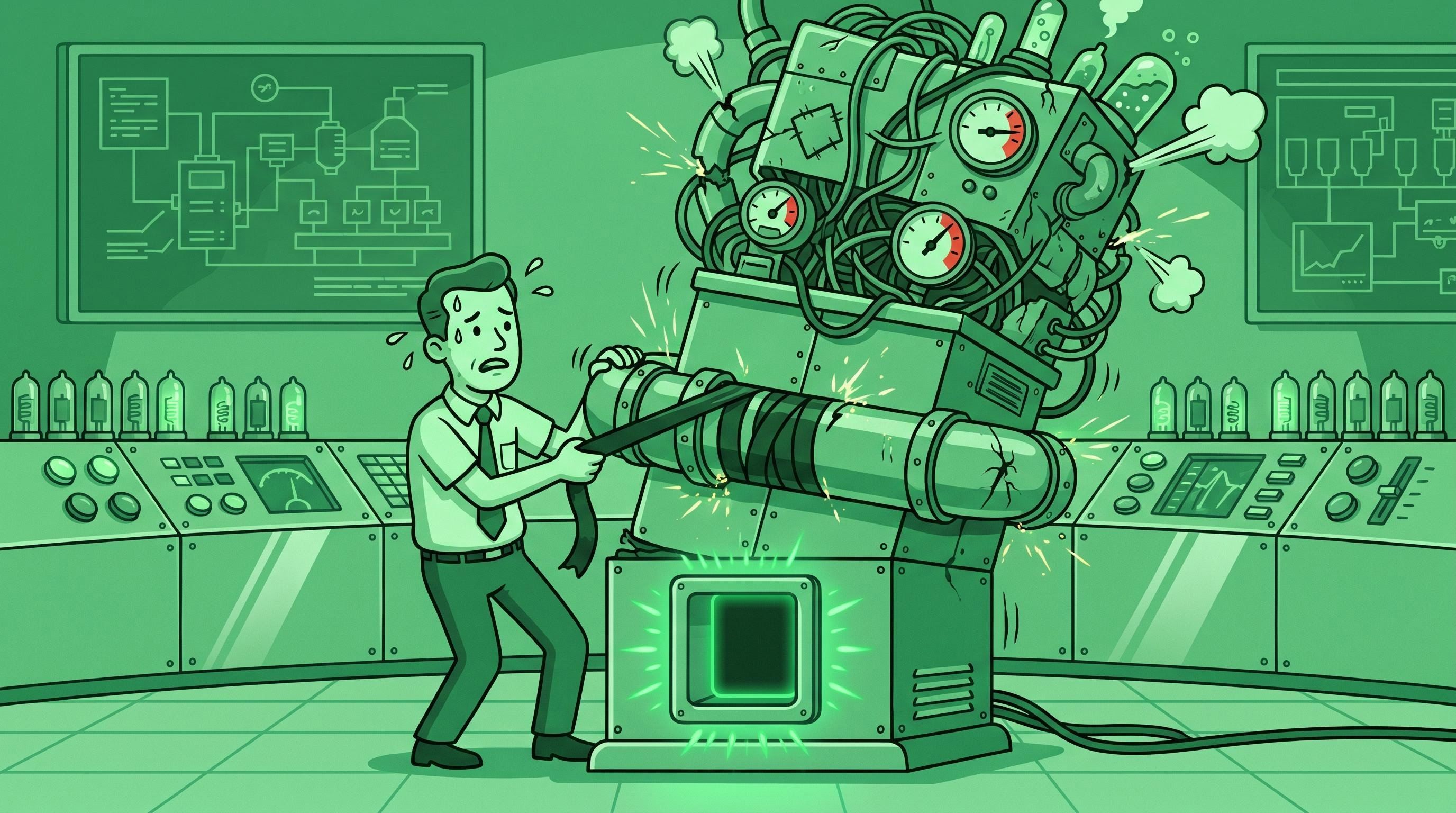
TL;DR. "We'll figure that out later" is the most expensive sentence in SMB operations. Deferred systems decisions — the CRM, the bookkeeping system, the SOP, the integration — compound at roughly 5–10x over three years, because the data, the people, and the workarounds keep accumulating around a hole. This is the case for naming the cost of waiting and the five decisions you cannot defer past your first $1M in revenue. Start with the STOA tools directory and the build-and-connect category.
The phrase that costs SMBs the most money
Every founder says it in year one. We'll figure that out later. Pick a CRM later. Get to bookkeeping later. Write SOPs later. Connect the tools later. None of those deferrals feels expensive in the moment — there's revenue to chase, payroll to make, a customer waiting. Picking a CRM is not on fire. So it gets pushed.
By year three, the cost has compounded into something the owner can feel but can't price. The salesperson keeps customer notes in three places. The bookkeeper closes the books eight days late every month because half the data lives in email. New-hire onboarding takes six weeks because the senior person who knows the system has to teach it line by line. None of this shows on a P&L. All of it costs more than the original decision would have.
The pattern is consistent enough to call a law: the cost of deciding is visible; the cost of not deciding is invisible. That asymmetry is why deferred decisions become the largest expense on a small business's books. This piece is the naming. It belongs alongside our companion case on the $600,000 problem — that piece quantifies the cost of disconnected systems, this one quantifies the cost of deferred decisions.
The four categories of deferred decisions that compound fastest
Not every deferred decision is expensive. Some compound and some don't. The four below are the ones we see compound fastest in SMB engagements — they accumulate cost every month, and the curve isn't linear.
Decision 1 — System of record for customers
We'll pick a CRM later. By the time later arrives, the same customer exists in five places — a salesperson's inbox, a spreadsheet, a Calendly account, an old email-marketing tool, QuickBooks. When the team finally picks a CRM, the migration cost isn't the per-seat license. It's eighty hours of cleanup to deduplicate four years of records that disagree about basic facts: which email is current, who is the buyer, what was promised.
Year one, picking a CRM is a $1,500 decision and a four-hour kickoff. Year three, it's a $15,000 data project and a week of arguments about whose spreadsheet is canonical. Same decision, ten times the cost.
Decision 2 — Source of truth for finances
We'll get bookkeeping organized later. Year one this looks like an owner doing books in a shoebox and a part-time bookkeeper closing the month from receipts. Year three: an owner who genuinely cannot tell which service line is profitable. Margins blur, pricing changes roll out on instinct, hiring plans get made on the wrong cash picture.
What was a $200/month QuickBooks subscription and an afternoon of setup becomes, in year three, a $20,000 cleanup with a forensic bookkeeper to rebuild three years of books before a bank, a buyer, or a tax authority forces the issue.
Decision 3 — Process documentation
We'll write SOPs later. This deferral compounds most violently, because the cost hides inside turnover. A small business runs because three or four people know how things work. None of it is written down. Year one this is fine — the people are there, they remember.
Year three, the senior project manager takes another job. The owner discovers on a Tuesday that nobody else knows how monthly client billing gets assembled, why three customers are billed quarterly, or what the override is when a vendor invoice doesn't match the PO. Six weeks of operational chaos and one hire later, the bill arrives — usually $30K–$80K of revenue at risk and the owner pulled back into the work they thought they'd escaped.
Decision 4 — Integration architecture
We'll connect things later. Each tool gets bought to solve a visible problem. Nobody draws the diagram of how data moves between them. Year one, integrating two tools is an hour of Zapier setup. Year three, the business has nine tools, fifteen unofficial workflows, and the integration project isn't "connect two tools" — it's a re-engineering of how the company moves information. We've documented this curve at length in the systems integration guide — a late connection runs ~5x what it would have at the start, because the data is now dirty and the people are dependent on the manual workaround.
The compound-cost math
Here's the curve we see in practice, plotted against the four decisions above. STOA-practice composites, not industry data — but the shape is consistent across dozens of audits.
| Decision deferred | Year 1 cost to do it right | Year 3 cost to fix it | Multiplier |
|---|---|---|---|
| Pick a CRM | $1.5K + 4 hrs setup | $12K–$20K data cleanup + migration | ~10x |
| Set up bookkeeping | $1K–$3K + monthly fee | $15K–$30K rebuild + audit | ~10x |
| Document core SOPs | 8–12 hrs of writing | $30K–$80K turnover/onboarding cost | 20x+ |
| First system integration | 4–8 hrs Zapier setup | $10K–$25K iPaaS project + cleanup | ~5x |
The drivers are the same in every row: data accumulates, people develop workarounds, and the business builds itself around the missing decision. By the time the team finally makes the call, they're not just choosing a tool — they're undoing years of accidental architecture that grew up to fill the gap.
The pattern has academic support. McKinsey's Tech debt: Reclaiming tech equity found 10–20% of every new-product technology budget gets diverted to fixing tech debt, and 60% of CIOs report tech debt has risen perceptibly in the past three years. Tech debt is the enterprise expression of the same dynamic — work you owe yourself for decisions you didn't make on time, plus interest. SMBs experience the same curve, smaller in absolute terms but sharper. Pegasystems' 2025 enterprise modernization research found the average global enterprise wastes more than $370M annually on the inability to modernize legacy systems — the upper bound of the same problem.
Why this happens — the psychology of deferral
Owners who defer these decisions aren't lazy or negligent. They're responding rationally to the decision economics in front of them.
The cost of making the decision is visible — a vendor demo, a contract, two hours on a Sunday writing an SOP, an uncomfortable conversation with a bookkeeper. Concrete, immediate, on the calendar. The cost of not making it is invisible — dispersed across thirty small frictions a week, none of which feel like a crisis, none of which generate a meeting or a report.
Behavioral economists call this present bias — humans heavily over-weight costs that are immediate relative to those that arrive over time. SMB owners aren't exempt. The cost of doing the work is here today; the cost of deferring is paid in installments by the future company that nobody on the leadership team is currently representing.
A second, structural driver: SMB owners measure their operations against other SMBs, and other SMBs are deferring the same decisions. If everyone in the peer group bleeds at the same rate, the bleeding looks normal. Normal isn't defensible — it's just unmeasured.
This isn't a moral failing. It's a calibration problem. The fix is to drag the deferred cost into the present, so the owner can see both sides of the trade at the same time. After that, the math gets obvious.
The five decisions you should not defer past $1M revenue
Past $1M in revenue, the compound math says you've already crossed the threshold where deferring costs more than deciding. We hold ourselves and our clients to a strict list — five decisions that aren't negotiable past the milestones below.
- System of record for finances — by month 6. A real bookkeeping system (QuickBooks Online, Xero, or equivalent) with a clean chart of accounts and one person owning monthly close. Month-6 cost: low four figures. Year-3 cost if deferred: low five figures, plus a pricing strategy made on the wrong margin picture.
- System of record for customers — by month 12. A CRM picked deliberately, populated with customer history, used by everyone who touches a customer. Framework for choosing without regret: our business software selection guide.
- Documented onboarding process — by month 18. The exact steps to bring a new employee, contractor, or client up to speed. Written, screen-recorded where useful, owned by one person. The first time a senior employee leaves, it pays for itself ten times over.
- First system integration — by year 2. One connection between your two highest-traffic tools — usually accounting ↔ CRM, project management ↔ invoicing, or website forms ↔ CRM. Not because integration solves everything, but because building the first one establishes that the stack is something you choose, not something that happens to you.
- SOPs for the three highest-frequency workflows — by year 2. Whatever your team does most often (sales handoff, project kickoff, monthly billing, customer onboarding). Not exhaustive — good enough that a competent new hire could follow it. Cost: ~twenty hours of writing. Cost of skipping: the next time anyone leaves.
These aren't best practices. They're minimum viable architecture for a business that wants to keep growing without the owner becoming the integration layer.
What to do if you're already in the deferred-decision hole
Most owners reading this will recognize themselves three or four decisions deep. Good — that's the most common state of any growing SMB. The fix isn't doing everything at once. It's a three-step climb out on a 90-day clock.
Step 1 — The audit
Block ninety minutes. Write down every system where business data lives — every SaaS tool, every spreadsheet, every shared inbox, every "person who knows how X works." Mark whether each is the system of record or whether the data also lives somewhere else. Then mark which of the four categories applies. Most owners are surprised by how much falls out of memory the second they start writing it down. Our technology self-audit walks the exercise in detail.
Step 2 — The triage
You can't fix everything in one quarter. Pick the deferral generating the most pain right now. Signal: which one is the team actively working around at least once a week? Fix that one first. Resist the urge to plan a comprehensive overhaul — overhauls are how SMBs spend $80K to fix what $15K and ninety days of focus would have solved.
Step 3 — The 90-day plan
One decision, ninety days, one named owner — usually not the founder. Three to five milestones, a small implementation budget, a defined "done" state. At day 90, it's no longer a deferred item. Three cycles into a year, three of the four categories are off the table. That's what graduating from deferred-decision debt looks like.
There's no version where you wake up tomorrow with all five decisions made. There's a version where ninety days from now, one of them is.
Frequently asked questions
What's the most expensive thing SMBs defer?
Process documentation and the customer system-of-record decision. SOPs are the most expensive because the cost hides inside turnover — the bill arrives the day a senior employee leaves, typically $30K–$80K in onboarding cost plus revenue at risk. The CRM decision is second, because by year three the data has fragmented across five places and cleanup costs ~10x what the original decision would have.
When should an SMB pick a CRM?
By month 12 at the latest, and earlier if the business acquires more than ten customers a month or if more than one person touches the customer relationship. Year one, it's a four-hour decision. Year three, it's a four-week data project. Pick before the data fragments.
How do I know if I have systems debt?
Three signs. (1) Your team has a recurring "person who knows how X works" — and X is a basic operational task. (2) You can't answer a question about the business (which service line is most profitable, average sales cycle, last quarter's churn) in under ten minutes. (3) Onboarding a new employee takes more than three weeks because the system "isn't really written down anywhere." Two of three: you have systems debt. All three: you're paying it actively.
Is it ever cheaper to defer a systems decision?
Yes — when the decision genuinely can't be made well with the information you have. A pre-product-market-fit startup shouldn't pick a CRM in month two. A business in active pivot shouldn't document SOPs that will be obsolete in six months. Defer when the underlying system isn't stable. Don't defer when it's been stable for a year and you simply haven't gotten to it. Only one of those compounds expensively.
Stop deferring. Start naming the cost.
STOA runs a free 30-minute Stack Audit — video, no slides, no pitch. We name the deferred decisions on your books, the compound cost on each, and the one decision worth pulling forward into the next 90 days. Book the audit, or browse the tools directory when you're ready to start choosing instead of deferring. For the integration side, the build-and-connect category is the right starting point.
The most expensive thing you can do is leave it as it is.
About the author. Alejandro Morales is a senior operations consultant and systems architect at STOA Digital Solutions. STOA helps SMB owners ($500K–$20M revenue) choose the right software, connect it, automate routine work, and build operations that don't depend on the owner being in every meeting. Triangle, NC.
Sources cited.
- McKinsey & Company — Tech debt: Reclaiming tech equity. McKinsey Digital, 2023. CIO survey: 10–20% of new-product technology budgets diverted to tech debt remediation; 60% of CIOs say tech debt has risen perceptibly in the last three years. https://www.mckinsey.com/capabilities/mckinsey-digital/our-insights/tech-debt-reclaiming-tech-equity?utmsource=stoa-agency&utmmedium=referral&utm_campaign=cost-of-figuring-it-out-later
- McKinsey & Company — Breaking technical debt's vicious cycle to modernize your business. McKinsey Digital, 2024. Companies that address tech debt systematically achieve 20–40% productivity gains. https://www.mckinsey.com/capabilities/mckinsey-digital/our-insights/breaking-technical-debts-vicious-cycle-to-modernize-your-business?utmsource=stoa-agency&utmmedium=referral&utm_campaign=cost-of-figuring-it-out-later
- Pegasystems — Enterprise modernization research, 2025. Average global enterprise wastes more than $370M annually on the inability to modernize legacy systems. https://www.pega.com/?utmsource=stoa-agency&utmmedium=referral&utm_campaign=cost-of-figuring-it-out-later
- Standish Group — CHAOS Report. Multi-decade research on IT-project outcomes; only ~29% of projects succeed, 52% are challenged, 19% fail outright; cost overruns average ~189% of original estimate. https://www.standishgroup.com/?utmsource=stoa-agency&utmmedium=referral&utm_campaign=cost-of-figuring-it-out-later
- STOA Digital Solutions — operational observations from SMB consulting engagements, 2024–2026. Year-1-to-Year-3 cost multipliers for deferred CRM, bookkeeping, SOP, and integration decisions; composite numbers anonymized.