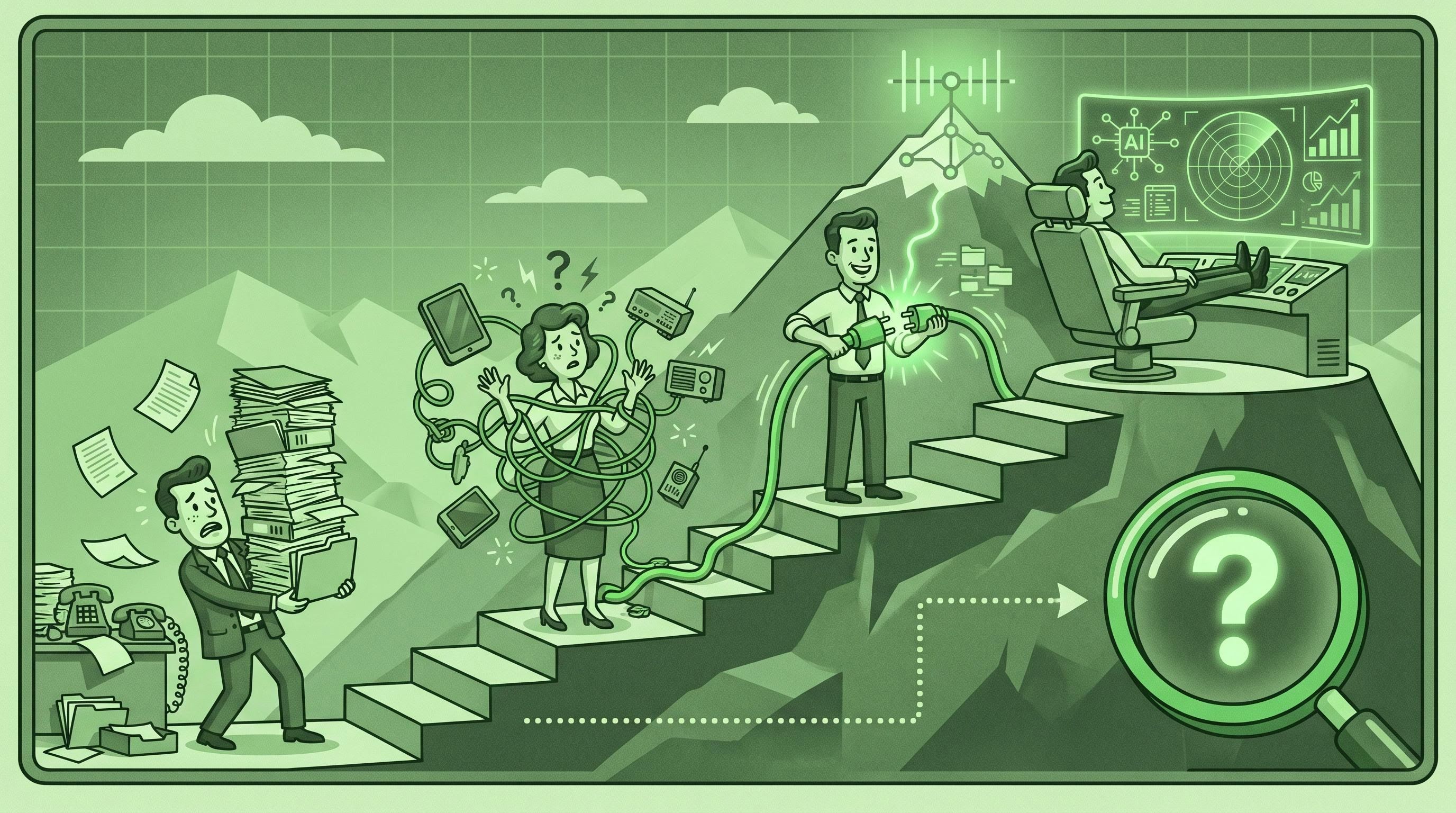
TL;DR. The Connected SMB Maturity Model is STOA's 5-stage framework for placing a small business on its operating-systems journey: Stage 1 Manual, Stage 2 Tooled, Stage 3 Connected, Stage 4 Optimized, Stage 5 Scaled. Most $1M–$20M businesses sit at Stage 2 (tools bought, nothing connected) and stall there for years. Each stage names the symptoms, the dominant problem, the next move, and the tools that fit. Use it to stop guessing where you are, and decide what to do next. Tools we've vetted by stage live in the STOA tools directory.
Why most maturity models fail SMBs
Every digital maturity model in print today was written for an organization with an Enterprise Architecture team. Forrester's Digital Maturity Model 5.0 assesses culture, governance, operating models, and platform strategy. Gartner, McKinsey, and BCG publish frameworks built on similar machinery — all assume a CIO, a multi-year roadmap, and a steering committee.
If you run a 25-person services business, none of those assumptions apply. You are the CIO. The "platform strategy" is whatever you signed up for on a Tuesday afternoon in 2022. The enterprise frameworks describe a journey that starts after the journey most SMBs are actually on.
We built this model after 100+ engagements with SMB owners — we kept watching $1M–$20M businesses try to apply enterprise frameworks, get nowhere, and conclude they were "behind." They weren't. They were running the right business with the wrong map. The actual progression we see is always the same five stages.
Stage 1 — Manual
Stage 1 Manual is a business that runs on spreadsheets, email threads, and the founder's memory. Zero integrated systems, because there are barely any systems. Data lives wherever it was first entered: customer list in Google Sheets, invoices in a folder of PDFs, the master version of everything in the founder's head. Not a failure mode — a starting point.
You're at Stage 1 if:
- Your "CRM" is a spreadsheet, your inbox, or both.
- New customers, projects, or invoices are tracked by someone manually adding rows somewhere.
- If the founder takes a two-week vacation, billing and follow-up stop.
- "I'll have to look that up" appears in client conversations more than once a week.
- Critical institutional knowledge is undocumented and lives in 1–3 people's heads.
Typical revenue band: $0–$2M.
The dominant problem: the founder is the operating system. Every decision, every customer, every dollar passes through one person. The business cannot scale past the founder's hours.
The next move: pick one CRM and one accounting tool. Don't pick three of each. Don't agonize for two months. The framework lives in our software selection guide — but at this stage, picking something matters more than picking the perfect thing.
Tools that fit Stage 1: HubSpot Free or Pipedrive for CRM. QuickBooks Online or Xero for accounting. Google Workspace or Microsoft 365 for everything else. $50–$200/month. The CRM tools we've reviewed sit in the directory.
Stage 2 — Tooled
Stage 2 Tooled is a business that has bought 5–10 SaaS tools, each chosen reactively, none connected to the others. Data exists in every tool but doesn't move between them. The integration layer is a person — usually the bookkeeper, an ops lead, or the founder — copy-pasting between systems on a Friday afternoon. Per BetterCloud's 2025 State of SaaS, the average organization runs 106 SaaS apps. SMBs run fewer — 8 to 15 in our experience — but the pattern is identical.
You're at Stage 2 if:
- You can list 5–10 software tools your team uses daily.
- Customer info lives in your CRM, accounting tool, support tool, and inbox — and the four don't agree.
- "Reconciling" is a recurring calendar item.
- New hires take three weeks to learn which tool is the source of truth for what.
- You've thought "maybe we should connect these" more than once and haven't.
Typical revenue band: $1M–$5M. The single most common stage we encounter.
The dominant problem: tooling sprawl with no plumbing. Every tool is doing its job in isolation, but the gaps between them are where the real cost lives. We documented the math in the $600,000 problem; the average $1M–$5M services business is leaking 6–10% of revenue here and can't see it on a P&L.
The next move: integrate the two highest-cost tools first. For services businesses, that's almost always CRM ↔ accounting. Pick the connection where the most expensive person spends the most time moving data. Run it 60 days. Then the next.
Tools that fit Stage 2: an integration platform at $20–$80/month — Zapier, Make, or n8n. Tradeoffs covered in our iPaaS vs custom integrations guide.
Stage 3 — Connected
Stage 3 Connected is a business whose core integrations are live: CRM talks to accounting, project ops talks to invoicing, leads from the website land in the CRM with the right tags. The integration layer is no longer a person — it's a small set of automations running on Zapier, Make, or n8n. This is the stage where the money starts to come back.
You're at Stage 3 if:
- Your CRM and accounting tool share customer data automatically.
- Closed deals trigger something downstream (an invoice, a project kickoff, a Slack notification).
- New leads are routed to the right person within minutes, not days.
- You can name 3–5 integrations running in your business and what each one does.
- You have a single source of truth for at least one critical record type (customer, project, deal) — and the team knows which one it is.
Typical revenue band: $3M–$15M. The stage where ROI compounds and operating margin starts to show it.
The dominant problem: integration debt. The connections you built six months ago start to break in months 12–18. APIs change, tokens expire, vendors update schemas. The Salesforce SMB Trends Report 2025 found growing SMBs are nearly twice as likely as declining ones to have an integrated tech stack (66% vs 32%) — but integration alone isn't enough. Maintaining it separates Stage 3 from Stage 4.
The next move: name an owner for the integration layer, document every flow in one place, add discipline — quarterly audit, credentials vault, what-to-check-when-it-breaks runbook.
Tools that fit Stage 3: the same iPaaS platform from Stage 2, now with 8–20 active flows. A shared password manager (1Password, Bitwarden). Workflow documentation in Notion or markdown. The automation patterns library catalogs playbooks for this stage.
Stage 4 — Optimized
Stage 4 Optimized is a business whose workflows are fully automated, whose dashboards reflect a single version of the truth in real time, and whose integration debt is actively managed. Routine ops — invoicing, onboarding, renewal reminders, status reporting — run themselves. Humans handle exceptions and judgment calls. Looks effortless from the outside; isn't. Requires someone whose job includes owning the operating system.
You're at Stage 4 if:
- Your monthly close happens because the books are already 90% closed when the period ends.
- Routine customer touchpoints (welcome, renewal, NPS, billing) run without anyone scheduling them.
- One dashboard pulls from multiple systems and the leadership team trusts it.
- Integration audits are calendared and someone owns the report.
- A new tool gets evaluated against your existing stack before purchase, not after.
Typical revenue band: $10M–$50M. Usually a business that has hired an ops leader or partnered with an external systems firm.
The dominant problem: the gap between automation and intelligence. Systems hum, data is clean, reports are accurate — but most decisions still rely on a human reading dashboards. Routine reading, classification, and summarization still consume meaningful hours.
The next move: layer AI on the integrated stack. Start with one boring, high-volume, language-heavy task. Measure before-and-after. The playbook lives in our AI no-hype guide.
Tools that fit Stage 4: the iPaaS platform plus AI tools wired into the workflow — Claude or ChatGPT for content, document AI for receipts, AI-augmented support tools (Help Scout AI Answers, Intercom Fin). The AI tools we've vetted for SMBs are sorted by use case, not buzzword. Monthly tooling cost runs $1,500–$6,000 for a 30-person business.
Stage 5 — Scaled
Stage 5 Scaled is a business where AI agents handle routine cognitive work, where data is self-serve, and where the integration layer is treated as a strategic asset. The owner isn't in every meeting. Decisions happen at the level they should, with the data they need, in real time. Stage 5 is rare in 2026; we expect it to be common by 2028.
You're at Stage 5 if:
- AI agents (not just AI tools) handle entire workflows — a triage agent that routes and responds, a research agent that drafts proposals from a brief.
- Your team can answer their own data questions without asking ops or analytics.
- The integration architecture is on someone's annual roadmap with budget attached.
- Tooling cost as a percentage of revenue is going down even as your team grows.
- A senior hire onboards in days because institutional knowledge lives in systems.
Typical revenue band: $25M+. Requires both operational and AI literacy on the leadership team.
The dominant problem: the agent stack itself — orchestration, observability, guardrails. Agents fail in ways traditional automation doesn't: they hallucinate, take unintended actions, require monitoring classical workflows don't. Treat agents like junior employees.
The next move: invest in agent orchestration and observability. Pick a primary agent platform, define the workflows where agents own the work top to bottom, instrument them. The pragmatic guide lives in our AI agent stack for SMBs piece.
Tools that fit Stage 5: an agent platform (n8n's AI Agent node, Zapier Agents, Make AI Agents). A vector store (Qdrant, Pinecone). Observability for agent runs. A defined model strategy across Claude, ChatGPT, and local LLMs.
The 6–18 month progression curve
Each transition takes time. A Stage 1 business doesn't move to Stage 3 in a quarter, no matter the budget.
Stage 1 → 2: 3–6 months. Bottleneck is adoption, not selection.
Stage 2 → 3: 6–12 months. The spike — most ROI in the framework lives here. Bottleneck is the decision to start: SMBs sit at Stage 2 for years because there's no forcing function. The build itself (3–8 integrations) is 4–10 weeks of part-time effort plus a 60-day stabilization window.
Stage 3 → 4: 12–18 months. Bottleneck shifts from technical to organizational. Most SMBs stall here because they refuse to assign an owner; integration debt accumulates and the business slides back to Stage 2.5 — too connected to give up, too poorly maintained to trust.
Stage 4 → 5: 12–24 months. AI literacy is the gating skill, not AI tools. The companies advancing here aren't spending most on AI — they're the ones whose ops leaders treat agents as a new category of employee.
Common stalls: tool-selection paralysis (1→2), no project owner (2→3), integration debt ignored until it breaks (3→4), AI hype-shopping or AI fear (4→5).
The 8-question self-assessment
Score one point for each yes. We use this exact set in the first 15 minutes of every Stack Audit.
- Do you have a single, named source of truth for customer data?
- When a deal closes, does an invoice generate without anyone manually entering the data?
- Can you name three or more integrations running in your business right now?
- Does a new lead from your website reach the right salesperson within minutes, automatically?
- Do you have a quarterly cadence for reviewing integration health?
- Is there one dashboard the leadership team trusts for monthly numbers, drawing from multiple systems?
- Are routine customer touchpoints (welcome, renewal, NPS) running without someone scheduling them each week?
- Does at least one AI tool handle a recurring workflow start to finish (not just "we use ChatGPT sometimes")?
Scoring: 0–1 = Stage 1 Manual. 2–3 = Stage 2 Tooled (where most SMBs sit). 4–5 = Stage 3 Connected. 6–7 = Stage 4 Optimized (rare). 8 = Stage 5 Scaled (the top 5% of SMBs we encounter).
If you felt the urge to round up, take an honest second pass. We've yet to meet an owner who underestimated their stage on first count.
Why most SMBs get stuck at Stage 2
Stage 2 is the gravity well. Three structural reasons.
The cost is invisible. Disconnected systems don't show up on a P&L line. Labor friction is buried in payroll, lost leads in noise, slow follow-up looks like normal sales velocity. Per the 2025 Salesforce SMB Trends Report, growing SMBs are 2x more likely to have an integrated tech stack than declining ones — but the struggling businesses don't see the gap. They see "we just need more leads."
No one owns the operating system. Sales has a salesperson, finance has a bookkeeper. The integration layer doesn't. It's everyone's job, which means it's no one's.
The "integration project" sounds bigger than it is. Owners hear "systems integration" and picture a six-figure consultant engagement — because that's what it meant ten years ago. The modern reality is $20–$300/month and 10–30 hours of setup for the first three integrations.
Way out is structural: pick a stage owner (even fractionally), pick a starting integration, set a 90-day milestone.
What unlocks each stage transition
Each transition has a single dominant unlock — the thing that, once done, makes the next stage inevitable.
Stage 1 → 2: Pick a CRM and an accounting tool. Don't run a procurement process. Don't read fifteen reviews. The decision is reversible, the cost is low, the act of picking is the unlock.
Stage 2 → 3: Build the first three integrations. Almost always: CRM ↔ accounting, calendar ↔ CRM, lead capture ↔ CRM. The priority framework lives in our systems integration guide. Build on Zapier, Make, or n8n; document each in a paragraph; assign an owner.
Stage 3 → 4: Add automation discipline. Quarterly integration audit. Credentials in a vault. A runbook for each flow. A single dashboard the leadership team uses for the monthly review.
Stage 4 → 5: Layer AI on clean data. Pick one task — support triage, proposal drafts, document extraction — and run an AI agent against it for 90 days with measurement. Then pick the next.
Each unlock is binary: done or not done. The framework isn't aspirational; it's diagnostic.
Where to read next, by stage
Forward path depends on where you sit. Stage 1 or 2: read our systems integration guide — the playbook for the Stage 2 → 3 jump. Stage 3: the iPaaS vs custom integrations breakdown. Stage 4: the AI no-hype guide. Stage 5: the AI agent stack for SMBs.
Frequently asked questions
What is the Connected SMB Maturity Model?
STOA's 5-stage framework for placing a small or mid-sized business on its operating-systems journey: Manual (Stage 1), Tooled (Stage 2), Connected (Stage 3), Optimized (Stage 4), Scaled (Stage 5). Each stage names symptoms, revenue band, dominant problem, next move, and the tools that fit. Built for $1M–$20M businesses — unlike enterprise digital maturity models from Forrester or Gartner that assume IT teams and capital budgets.
How long does it take to move from Stage 2 to Stage 3?
Six to twelve months for most SMBs. The technical work — building three to eight integrations on Zapier, Make, or n8n — takes four to ten weeks of part-time effort. The rest is the 60-day stabilization window plus the lead time on actually deciding to start. The biggest delay is rarely technical.
What's the average maturity stage for an SMB?
Stage 2 (Tooled). Across 100+ engagements, the median $1M–$10M services business sits at Stage 2: five to ten SaaS tools in use, almost none connected. The 2025 Salesforce SMB Trends Report corroborates — only about a third of declining SMBs and two-thirds of growing ones have integrated stacks.
Can a Stage 2 SMB skip to Stage 4 or 5?
Almost never successfully. We see owners try — usually after reading an AI hype piece — and it fails for the same reason every time: AI on disconnected systems produces disconnected outputs. The fastest path from Stage 2 to Stage 5 still goes through Stages 3 and 4, typically 3–4 years.
What's the biggest jump in the maturity model?
Stage 2 → Stage 3 — the integration jump. SMBs at Stage 2 are leaking 6–10% of revenue to disconnected systems (the $600,000 problem); businesses completing Stage 2 → 3 typically recover 60–80% of that leakage within twelve months. No other transition has the same payback ratio.
Where do most SMBs get stuck?
Stage 2. It's a gravity well — cost invisible on a P&L, no one assigned to fix it, project sounds bigger than it is. Most SMBs sit at Stage 2 for three to seven years before either advancing or being out-competed.
Stop guessing where you sit. Run the audit.
STOA runs a free 30-minute Stack Audit — video, no slides, no pitch. We place your business on the Connected SMB Maturity Model, name the unlock you need to reach the next stage, and recommend the three tools that fit. Book the audit, or browse the tools we've vetted. If you're at Stage 4 or 5 and the question is what AI to layer in, the AI Tech Advisor walks you through it in a few minutes.
Either way — the most expensive thing you can do is leave the stage you're in unnamed.
About the author. Alejandro Morales is a senior operations consultant and systems architect at STOA Digital Solutions. STOA helps SMB owners ($500K–$20M revenue) choose the right software, connect it, automate routine work, and build operations that don't depend on the owner being in every meeting. Based in the Triangle, NC; serving the US.
Sources cited.
- Software Engineering Institute, Carnegie Mellon University — Capability Maturity Model for Software (Version 1.1). The original 5-level maturity framework (Initial → Managed → Defined → Quantitatively Managed → Optimizing), developed 1986–1991 by Watts Humphrey and team. https://www.sei.cmu.edu/documents/1092/199300500116211.pdf?utmsource=stoa-agency&utmmedium=referral&utm_campaign=connected-smb-maturity-model
- Forrester Research — The Digital Maturity Model 5.0. Enterprise digital maturity across culture, organization, technology, and insights. https://www.forrester.com/report/The-Digital-Maturity-Model-50/RES137561?utmsource=stoa-agency&utmmedium=referral&utm_campaign=connected-smb-maturity-model
- Salesforce — Small & Medium Business Trends Report (6th Edition), 2025. Surveys 3,350 SMB leaders. Growing SMBs are 2x as likely as declining ones to have an integrated tech stack (66% vs 32%). https://www.salesforce.com/resources/research-reports/smb-trends/?utmsource=stoa-agency&utmmedium=referral&utm_campaign=connected-smb-maturity-model
- BetterCloud — 2025 State of SaaS Report. Average organization runs 106 SaaS apps with a 5% YoY decrease, the first sustained consolidation since SMB SaaS adoption began. https://www.bettercloud.com/resources/state-of-saas/?utmsource=stoa-agency&utmmedium=referral&utm_campaign=connected-smb-maturity-model
- STOA Digital Solutions — operational observations from 100+ SMB consulting engagements, 2024–2026. Stage progression and time-in-stage figures are practice observations; composite stage descriptions are anonymized.